


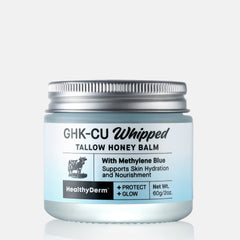

Tallow does not treat eczema, and there are no published trials of a tallow product in people with atopic dermatitis. What a tallow balm can do is what a rich moisturizer does on any dry skin: soften rough patches and slow water loss from the surface. Dermatology guidelines put moisturizers at the center of everyday eczema care, alongside prescribed treatment, not instead of it. There is also one specific reason for caution with tallow that most brands never mention, and it is covered below.
If you searched this question you have probably already seen the two extremes. Hospitals and allergy foundations publishing careful warnings. Brands and Reddit threads saying tallow fixed eczema that nothing else touched. Neither is much use when you are standing in your bathroom deciding whether to put a balm on a dry patch of skin.
Here is the honest middle. One note on scope: this article is about adult skin. Eczema on a baby or a child is a decision for a pediatrician, and we do not cover it here.
What eczema is, and where a moisturizer actually fits
Atopic dermatitis is an inflammatory skin disease. It involves an impaired skin barrier and immune activation, and in some people an inherited change in filaggrin, a protein that helps hold the outer layer of skin together. That combination is why eczema-prone skin loses water quickly, feels tight and reactive, and flares.
A moisturizer does not switch off the inflammation. What it does is reduce water loss and make dry skin more comfortable. The American Academy of Dermatology's guideline on topical therapy (Eichenfield and colleagues, 2014) calls moisturizers a cornerstone of atopic dermatitis care and recommends applying them soon after bathing. A 2017 review in Clinical Medicine & Research (Purnamawati and colleagues) describes moisturizers in the same way across many kinds of dermatitis: as daily maintenance, and as a support used alongside treatment.
Two details in that guideline matter for this question. First, head-to-head trials of specific moisturizers are few, and the ones run so far have not shown any single product to be better than the others. Second, the evidence is about moisturizers as a category, tested with conventional products. None of it used tallow.
So the useful question is not "does tallow cure eczema." It is "is a tallow balm a reasonable moisturizer for dry, eczema-prone adult skin." That question has a more interesting answer.
| What tallow can reasonably do | What it cannot do |
|---|---|
| Soften dry, rough, scaly skin | Reduce the underlying inflammation |
| Slow water loss from the surface | Replace a prescribed topical steroid or non-steroid anti-inflammatory |
| Ease the tight feeling that follows washing | Prevent eczema from developing |
| Serve as the sealing step over damp skin or a water-based product | Go on infected, weeping or broken skin |
| Suit someone who prefers a short ingredient list | Claim any tested advantage over standard moisturizers |
Is beef tallow good for eczema? What the research shows
There are no published controlled trials of a tallow product in people with atopic dermatitis. That is the plain state of the evidence and it is worth saying clearly, because a lot of pages selling tallow imply otherwise.
The most thorough review to date is a 2024 scoping review in Cureus by Russell and colleagues. They searched PubMed and EMBASE, screened 147 papers and found 19 that met their criteria. Those 19 were comparative studies, basic science and animal work, and several tested formulas in which tallow was one ingredient among others. The authors found support for tallow's moisturizing properties, found the most disagreement between sources on side effects, and called for controlled research in people. One detail rarely makes it onto tallow product pages: in the comparative studies they reviewed, other ingredients, including pumpkin seed oil and linoleic acid, were more hydrating than tallow.
What the broader literature supports is the category, not the ingredient. Moisturizers reduce water loss and are central to eczema care. Tallow is an emollient and an occlusive. So the reasonable inference is that a tallow balm will behave roughly like other rich moisturizers on dry, eczema-prone skin. That is a modest claim, and it is the only one the evidence carries.
It also turns the marketing story around. Tallow is not doing something special that petrolatum or a ceramide cream cannot. It is doing something ordinary, in a texture some people prefer.
The oleic acid question nobody selling tallow mentions
This is the part worth reading twice.
Tallow's most abundant fatty acid is oleic acid, followed by palmitic and stearic acid, according to the same 2024 review, which also notes that tallow contains proportionally little linoleic acid. That balance matters on a compromised barrier.
In a 2013 study in Pediatric Dermatology, Danby and colleagues recruited 19 adult volunteers, with and without a history of atopic dermatitis, into two randomised forearm-controlled studies. Olive oil, which is high in oleic acid, applied to one forearm for four weeks significantly reduced the integrity of the outer skin layer and caused mild redness, in people with and without an eczema history. Sunflower seed oil, which is high in linoleic acid, preserved barrier integrity, caused no redness and improved hydration in the same volunteers.
That study was about olive oil, not tallow. Nobody has run the equivalent study on a tallow balm, so extending the finding is an inference and we are labelling it as one. But it points the same direction for anyone whose barrier is already impaired, and it is the single most relevant piece of research to this question. A tallow brand that leaves it out is not giving you the full picture.
The practical upshot is not "never use tallow." It is: if you have active eczema, patch test on a small area first, do not start on an inflamed patch, and if the skin gets redder or itchier over the first week, that is your answer. Some people with eczema-prone skin do fine with rich animal fats. Some do not, and now you know one plausible reason why.

How tallow compares with the standard options
| Option | What the evidence says | Notes |
|---|---|---|
| Petrolatum | A standard occlusive named in the AAD guideline. No trial has shown it better than other moisturizers | A single ingredient, so little to react to. A heavy feel is the usual complaint |
| Ceramide creams | Built around barrier lipids. In the one head-to-head study the guideline describes (39 people), a ceramide cream did no better than a petroleum-based protectant over three weeks | Often the first suggestion for atopic skin |
| Sunflower seed oil | Preserved the barrier and improved hydration in the Danby study (19 adults) | High in linoleic acid |
| Beef tallow balm | No studies in eczema | Emollient and occlusive. High in oleic acid, low in linoleic acid. Check the other ingredients |
If your goal is the best-evidenced choice for eczema, the honest answer from the guideline is that no moisturizer has been shown to beat the others, and tallow has not been tested at all. If your goal is a rich, short-ingredient balm you will keep using on dry skin that is not flaring, tallow is a defensible option. The moisturizer you actually use beats the better-studied one sitting in a drawer.
Watch the other ingredients, not just the tallow
Most tallow balms are not only tallow. Honey, beeswax, essential oils, botanical extracts and fragrance are common, and some of those are known contact allergens. A natural ingredient list is not automatically a gentle one.
Read the full list before you buy, and be more suspicious of a balm with ten botanical extracts than one with five plain ingredients. Our own Tallow Honey Balm contains grass-fed beef tallow, raw honey, beeswax, jojoba oil and vitamin E, with no added fragrance. Honey and beeswax can cause reactions in a small number of people, which is exactly why we say patch test rather than say gentle.
Jar packaging is worth a thought too. Dipping fingers into an open jar again and again is not ideal hygiene, especially if any skin is broken. Use clean hands or a small spatula.
What about beef tallow for psoriasis?
Same shape of answer, different disease. Psoriasis is driven by accelerated skin cell turnover and immune activity. Moisturizers can make scaly skin feel softer and more comfortable between treatments, but they do not change the underlying process.
There is no research on tallow in psoriasis. Anything you read claiming otherwise is extrapolating. If a rich balm makes dry, scaly skin more comfortable, that is a legitimate small benefit and it is all we would claim for it.
If you want to try it, here is a sensible way
- Not on a flare. Start on skin that is dry but calm, not on an inflamed, weeping or cracked patch.
- Patch test properly. Use it on the same small area of calm skin for several days before going wider. A single application tells you very little.
- Apply to damp skin. A water-free balm has no water to give you. The AAD guideline recommends moisturizing soon after bathing, so put it on within a few minutes of washing, or over a water-based moisturizer, so there is moisture to seal in.
- Use a thin layer. Warm it between your fingertips and press it on. Rich balms go further than people expect.
- Keep your prescribed treatment going. Moisturizers work alongside anti-inflammatory treatment. Stopping the treatment because the balm feels nice is how a flare gets worse.
- Give it a couple of weeks, then judge honestly. Better: less tightness, less roughness. Worse: more redness, more itch, new bumps. Worse means stop.
When to stop and see a doctor
Stop and get medical advice if the skin becomes more inflamed after starting, if you see yellow crusting, weeping, pus or spreading redness, which can indicate infection, if the eczema is not controlled by your current treatment, or if it is affecting your sleep. None of that is a skincare problem and no balm is the answer to it.
What we are not claiming
We sell a tallow balm, so read this section with that in mind and then check it against the references below.
We are not claiming our balm treats eczema, heals eczema, or is better for eczema than a pharmacy moisturizer. There is no trial evidence for any of that, and the most relevant study to the question, the Danby olive oil work, is a reason for caution rather than confidence. What we will say is that a plain five-ingredient balm is a reasonable moisturizer for dry, calm, eczema-prone skin in an adult who patch tests it and keeps using their actual treatment. That is the whole claim.
If that reads as underselling, it is deliberate. The category has a lot of pages telling people a rendered fat fixed a chronic inflammatory disease, and some of those people are delaying real care.
Frequently asked questions
Does beef tallow help eczema?
There is no clinical evidence that it does. Tallow is an emollient, so it can soften dry, rough skin and slow water loss the way other rich moisturizers do, but no trial has tested it in people with eczema. Use any moisturizer alongside prescribed treatment, not instead of it.
Can beef tallow cure eczema?
No. Eczema is a chronic inflammatory condition with no cure, and no moisturizer of any kind cures it. Anyone selling tallow as a cure is making a claim their product cannot support.
Is tallow safe on eczema-prone skin?
It is not risk-free. Tallow's main fatty acid is oleic acid, and olive oil, also high in oleic acid, damaged the skin barrier of adults with and without a history of eczema in a 2013 randomised forearm study. Patch test on a small area of calm skin for several days before wider use.
Is tallow better than petrolatum or a ceramide cream for eczema?
There is no evidence that it is. The American Academy of Dermatology guideline notes that head-to-head trials have not shown any one moisturizer to be superior, and tallow has not been studied in eczema at all. Its appeal is texture and a short ingredient list, not proven performance.
Is beef tallow good for psoriasis?
There is no research on tallow in psoriasis. A rich balm can make dry, scaly skin feel more comfortable, as other moisturizers can, but it does not change the disease itself.
How long before I know if it is working?
Give it a couple of weeks on calm skin. If redness or itching increases in the first week, stop.
References
- Russell MF, Sandhu M, Vail M, Haran C, Batool U, Leo J. Tallow, rendered animal fat, and its biocompatibility with skin: a scoping review. Cureus. 2024;16(5):e60981. doi:10.7759/cureus.60981. PMC
- Danby SG, AlEnezi T, Sultan A, Lavender T, Chittock J, Brown K, Cork MJ. Effect of olive and sunflower seed oil on the adult skin barrier: implications for neonatal skin care. Pediatric Dermatology. 2013;30(1):42-50. doi:10.1111/j.1525-1470.2012.01865.x. PubMed
- Eichenfield LF, Tom WL, Berger TG, et al. Guidelines of care for the management of atopic dermatitis: section 2. Management and treatment of atopic dermatitis with topical therapies. Journal of the American Academy of Dermatology. 2014;71(1):116-132. doi:10.1016/j.jaad.2014.03.023. PubMed
- Purnamawati S, Indrastuti N, Danarti R, Saefudin T. The role of moisturizers in addressing various kinds of dermatitis: a review. Clinical Medicine & Research. 2017;15(3-4):75-87. doi:10.3121/cmr.2017.1363. PMC
Related reading
For the general evidence picture on tallow beyond eczema, see Is Beef Tallow Good for Skin? An Evidence Check. If your concern is congestion rather than eczema, The Comedogenic Rating Myth explains why ingredient ratings predict less than people assume. For dryness after 50 rather than a diagnosed condition, read Beef Tallow for Mature Skin. If washing leaves eczema-prone skin tight, our piece on tallow face wash and non-foaming cleansers covers the step before the balm. And if you are reacting to a product and are not sure whether it is the tallow or something else, our guide to copper peptide side effects covers how to tell irritation from a genuine reaction. You can see the full range in our tallow skincare collection.