




Beef tallow moisturizer is having a moment with women over 50, and some of the enthusiasm is earned. Tallow is a rich emollient and occlusive: it softens rough skin and slows water loss from the surface, which matters more once skin makes less oil of its own. What it is not is a revolution. There are no published clinical trials of a tallow moisturizer in mature skin, and a lot of what circulates online about it, including some of what this page used to say, does not hold up.
This is the honest version: what tallow is, what changes in skin after menopause, what the research supports, and how to tell whether a tallow balm suits you.

What is in beef tallow?
Tallow is rendered beef fat. Its most abundant fatty acid is oleic acid, followed by palmitic and stearic acid, according to a 2024 scoping review in Cureus by Russell and colleagues. It contains comparatively little linoleic acid.
You will often read that tallow "matches human sebum." It is closer to say that tallow shares some building blocks with skin lipids. Human sebum is mostly squalene, wax esters and triglycerides, and the lipids that hold the outer skin layer together are mainly ceramides, cholesterol and fatty acids, as Wertz describes in a 2018 review in the Journal of Lipids. Tallow is mostly triglycerides. Similar ingredients are not the same structure, and similarity alone does not prove deeper absorption or better results.
What changes in skin after 50?
Oil production is one of the clearer changes. In a classic 1979 study of sebaceous gland activity, Pochi, Strauss and Downing found that sebum output in women decreases gradually after menopause, while in men it stays roughly level until about 80. Less surface oil is part of why skin that never felt dry before can feel tight and rough in your fifties.
That is where a rich moisturizer earns its place. It does not restore oil glands or rebuild collagen. It replaces some of the surface film and slows the water loss that follows.
Does grass-fed matter?
For the beef itself, the diet does change the fat. A 2010 review in Nutrition Journal by Daley and colleagues summarised three decades of research: grass-based diets raise omega-3 fatty acids and conjugated linoleic acid in beef, and several studies found higher levels of precursors for vitamins A and E.
What nobody has shown is that those differences survive rendering into a skincare balm in amounts that change how skin looks. Grass-fed sourcing is a reasonable supply-chain preference. It is not evidence that a grass-fed balm works better on your face, and we would not claim that it does.
What the research actually supports
The most thorough look at the evidence is the Russell review. The authors searched PubMed and EMBASE, screened 147 papers and found 19 that met their criteria. Those were comparative studies, basic science and animal work. They found support for tallow's moisturizing properties, found the most disagreement on side effects, and called for controlled research in people. In the comparative studies they reviewed, some other ingredients, including pumpkin seed oil and linoleic acid, were more hydrating than tallow.
So the defensible claim is modest. A tallow balm behaves like other rich emollients: it can make dry skin feel softer and more comfortable, and it slows water loss from the surface. It has not been shown to outperform petrolatum, ceramide creams or plant oils, and it has not been shown to change wrinkles, firmness or elasticity.
| Claim you will see | What the evidence says |
|---|---|
| "Tallow softens and seals in moisture" | Reasonable. That is what emollients and occlusives do |
| "Tallow is identical to human sebum" | No. It shares fatty acids with skin lipids but is mostly triglycerides |
| "Clinical trials prove tallow beats conventional creams" | No such trials have been published |
| "Tallow is hypoallergenic" | Not established. Reactions are possible, and other ingredients in the jar matter |
| "Tallow reduces wrinkles" | No evidence. Comfort and softness, yes; structural change, no |
Is tallow safe for sensitive skin?
Often, but not automatically. Tallow balms usually contain other ingredients, such as honey, beeswax, essential oils or fragrance, and any of them can cause a reaction in some people. Oily or acne-prone skin does not always get on with rich occlusives either. Patch test on a small area for several days before using a new balm on your whole face.
If you have eczema or another diagnosed skin condition, keep your prescribed treatment going. Our article on tallow for eczema covers what the evidence does and does not support, including one study that is a genuine reason for caution.
How to use a tallow moisturizer after 50
- Cleanse gently. A non-foaming cleanser strips less of the oil mature skin is already short on.
- Apply to damp skin, or over a water-based serum. A balm has no water of its own. It works by holding in moisture that is already there.
- Use a thin layer. Warm it between your fingertips and press it on. Rich balms go further than people expect.
- Night is easiest. In the morning, keep it thin and finish with sunscreen.
What to expect, honestly
Comfort and softness show up quickly, often the first night, because they are a surface effect. That is the main benefit and it is a real one. Do not expect a balm to fade wrinkles, firm skin or lift anything. If loss of firmness is your main concern, you need an active ingredient with evidence behind it, and tallow can be the base that seals it in rather than the thing doing the work.
What to look for in a tallow moisturizer
- A short, complete ingredient list that is easy to find.
- No added fragrance if your skin is reactive.
- Claims tied to the finished product. Be wary of any brand quoting studies you cannot look up.
- Clean packaging. Use a spatula or clean hands with a jar.
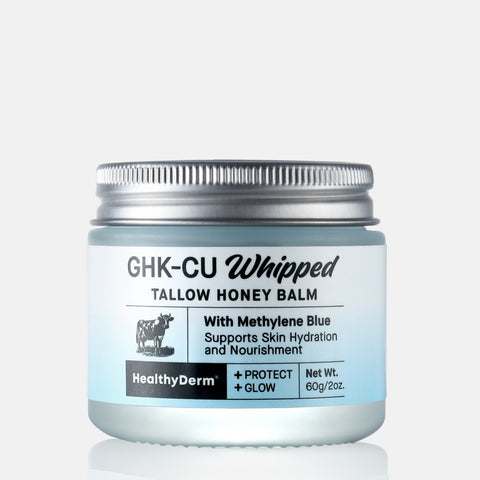
Our Tallow Honey Balm has five ingredients: grass-fed tallow, raw honey, beeswax, jojoba oil and vitamin E, with no added fragrance. It is a moisturizer, and we sell it as one.
A note on this page
An earlier version of this article cited studies we could not find when we checked them, including a 12-week trial of tallow in post-menopausal women and an absorption study credited to a university research bulletin. We have removed every figure we could not trace to a published source. If a claim about tallow comes with a study attached, it should be one you can look up yourself.
References
- Russell MF, Sandhu M, Vail M, Haran C, Batool U, Leo J. Tallow, rendered animal fat, and its biocompatibility with skin: a scoping review. Cureus. 2024;16(5):e60981. doi:10.7759/cureus.60981. PMC
- Wertz PW. Lipids and the permeability and antimicrobial barriers of the skin. Journal of Lipids. 2018;2018:5954034. doi:10.1155/2018/5954034. PubMed
- Pochi PE, Strauss JS, Downing DT. Age-related changes in sebaceous gland activity. Journal of Investigative Dermatology. 1979;73(1):108-111. doi:10.1111/1523-1747.ep12532792. PubMed
- Daley CA, Abbott A, Doyle PS, Nader GA, Larson S. A review of fatty acid profiles and antioxidant content in grass-fed and grain-fed beef. Nutrition Journal. 2010;9:10. doi:10.1186/1475-2891-9-10. PubMed