




The short answer
A lotion for crepey skin on arms and legs has to do two jobs at once: replace the lipids the skin has stopped making, and supply an active that signals collagen production. Most body lotions only do the first, which is why the skin feels better for a few hours and looks the same by evening. Look for a rich, lipid-based formula (tallow, shea, squalane, ceramides) plus either a retinoid or copper peptides. Apply it to damp skin straight after showering, every day. Expect softer texture in one to two weeks and, at best, a modest firmness change at eight to twelve weeks.
The honest part, which most pages leave out: exactly one randomised controlled trial has ever used crepiness on the arms as an outcome measure. It is Kavali and colleagues, 2021, 40 women aged 40 to 60, one arm treated and the other given a placebo moisturiser for twelve weeks. It found the treated arm did better on every measure. It also published no effect sizes and no p-values in its abstract, and it was run by the company that makes the product. Everything else you will read about arms and legs is borrowed from facial studies. We make a body treatment for this, so we have every commercial reason to tell you otherwise, and we are not going to.
Price is a poor guide here. A well-formulated fifteen dollar lotion applied daily will beat a ninety dollar one used twice a week.
How good is the evidence, treatment by treatment?
This is the table we could not find anywhere else, so we built it. Each row grades the evidence for that treatment on arm and leg skin specifically, not on the face.
| Treatment | Best study on body skin | Design | What it measured | Evidence grade for arms and legs |
|---|---|---|---|---|
| Lipid-rich moisturiser plus active | Kavali et al. 2021 [3] | Randomised, double-blind, split-body, placebo-controlled. 40 women aged 40 to 60, twice daily, 12 weeks, 10 biopsies | Clinical grading of laxity, crepiness, roughness and photodamage on the upper arm, plus ultrasound skin density | Moderate. The only randomised trial on this body site. Industry run, and the abstract reports direction of effect without effect sizes or p-values |
| Retinoids (retinol, tretinoin) | Weiss et al. 1988 [4] | Double-blind, vehicle-controlled. 15 on tretinoin, 15 on vehicle, median age 50. Treated photodamaged forearm and face | Clinical signs of photoaging, chiefly fine wrinkling | Moderate, partly transferable. The forearm was treated, which is more than most actives can claim. Sample size 30, industry supported |
| Copper peptides (GHK-Cu) | Badenhorst et al. 2016 [6] | Randomised, double-blind, split-face. 40 women aged 40 to 65, twice daily, 8 weeks, 3D stripe-projection imaging. The comparison against a plain serum used 20 of them | Facial wrinkle volume and depth, at one wrinkle near the corner of the eye | Low for this body site. The result is real, significant and facial. Applying it to arms and legs is an extrapolation, and the authors attribute the effect to their nano-carrier delivery system rather than to the serum base |
| Humectants (glycerin, hyaluronic acid, urea) | No body-site trial located | n/a | n/a | Low, and the mechanism is short-lived. They move water into the outer layer. That is real and it is not structural |
| Gentle exfoliants (lactic acid, higher-percentage urea) | No body-site crepiness trial located | n/a | n/a | Low. Well supported for rough, dry skin. Not studied against crepiness as an outcome |
| Topical collagen as an ingredient | Bos and Meinardi 2000 [5] | Review of skin penetration by molecular weight | Whether molecules above roughly 500 daltons cross intact stratum corneum | Evidence against. Hydrolysed collagen is far above that threshold. It sits on the surface as a film |
| Drinking more water | No trial supports it in hydrated people | n/a | n/a | Evidence against, unless you are actually dehydrated |
What causes crepey skin on arms and legs?
It looks like wrinkling, but the underlying process differs, and that is why face products underperform on it.
- Lipid loss. Body skin has far fewer sebaceous glands than the face, and sebaceous output falls steadily with age. Jacobsen and colleagues (1985) measured sustainable sebaceous wax ester secretion in 109 men and 167 women aged 15 to 97 and found output declining by roughly 23 percent per decade in men and 32 percent per decade in women. That study measured foreheads, which have far more glands than a forearm, so the percentages describe the direction rather than the size of the change on your limbs. Without those lipids the barrier leaks water, and dehydrated skin creases into fine lines at the slightest movement.
- Collagen decline. Shuster, Black and McVitie (1975) measured forearm skin collagen density in 72 men and 76 women aged 15 to 93 and found it falling close to linearly, by about 1 percent a year across adult life, at a similar rate in both sexes. Two details matter and are usually dropped. The loss is not specific to the mid-twenties onward, and Shuster's own later reading of his data is that it is comparable across body sites and not caused by sun exposure. This page previously said skin loses "roughly 1 percent of its collagen per year from the mid-twenties, and much faster in the first five post-menopausal years." The 1 percent figure is sound and now carries its source. The mid-twenties starting point did not trace to any primary study, so it is gone. Loss does accelerate after menopause, and we are deliberately not putting a number on it: the per-year rates in circulation are attributed to work by Brincat and colleagues in 1987 that we have not been able to open and read, and the much-repeated claim that women lose 30 percent of dermal collagen in the first five postmenopausal years does not appear in any primary paper we could find. A figure we cannot check is a figure we will not print.
- Sun damage. Forearms, shins and the backs of hands take decades of unprotected ultraviolet, which degrades elastin and the dermal matrix. This is a separate process from the age-related collagen decline above, which is why the inside of your upper arm usually looks younger than the outside even though both are the same age.
- Rapid weight change and dehydration both make it more visible, though neither is the underlying cause.
The practical consequence: a lotion that only adds water will fail, because the causes above are mostly structural.

What should be in a lotion for crepey skin?
| Ingredient type | Examples | What it does for crepey skin | Priority |
|---|---|---|---|
| Collagen-signalling actives | Copper peptides (GHK-Cu), retinol, retinaldehyde | The only category that addresses a structural cause. Supports new collagen in the dermis | Essential. Without one of these you have a moisturiser, not a treatment |
| Barrier lipids | Tallow, ceramides, squalane, shea butter | Replaces what body skin stopped producing. Holds water in so the fine creasing softens | Essential. This is what makes the improvement last past lunchtime |
| Humectants | Glycerin, hyaluronic acid, urea | Pulls water into the outer layer. Real but temporary plumping of fine lines | Useful, but only when paired with lipids to seal it in |
| Gentle exfoliants | Lactic acid, urea at higher percentages | Clears rough buildup so everything else absorbs, and improves how light hits the skin | Nice to have. Watch for irritation on thin, fragile skin |
| Antioxidants | Vitamin C, vitamin E, niacinamide | Limits further oxidative damage. Preventive rather than corrective | Nice to have |
| Collagen as an ingredient | Hydrolysed collagen in a topical lotion | Almost nothing. See the molecular weight problem below | Skip. It is marketing, not mechanism |
On that last row, the objection is specific rather than vague. Bos and Meinardi (2000) set out what has become known as the 500 dalton rule: compounds much heavier than about 500 daltons do not cross intact stratum corneum in useful amounts. Their argument rests on three observations, that nearly all common contact allergens fall under 500 daltons, that the topical drugs which work in dermatology fall under it, and that every drug used in transdermal patches falls under it. Hydrolysed collagen peptides are typically in the thousands of daltons, and intact collagen is far heavier again. A lotion containing collagen can still be a perfectly good moisturiser. It is not delivering collagen into your dermis.
Retinol or copper peptides for body skin?
Both signal collagen production, and they get there differently.
Retinoids have the deepest evidence base and are the dermatology default. Weiss and colleagues (1988) ran the trial that started it: 15 patients on 0.1 percent tretinoin against 15 on vehicle, median age 50, treating photodamaged forearm and facial skin, with improvement reported chiefly in fine wrinkling. Thirty people is a small trial by modern standards and the work was industry supported, but it is one of very few studies to have treated forearm skin at all. The catch on arms and legs is irritation and sun sensitivity across large areas of already-thin skin, usually in the driest months. A lot of people start a body retinoid, flake for three weeks, and quit. A treatment you abandon does nothing.
Copper peptides are gentler, have no retinisation period, and do not increase photosensitivity, which matters on limbs that see daylight. The best controlled evidence is Badenhorst and colleagues (2016): 40 women aged 40 to 65, randomised, double-blind and split-face, applying the test serum to one side and a comparator to the other twice daily for eight weeks, with a single wrinkle near the corner of the eye measured by 3D stripe-projection imaging. In the twenty women whose other side received the plain serum base, wrinkle volume fell 24.1 percent from baseline on the GHK-Cu side against 15.0 percent on the base, a 55.8 percent relative improvement (p below 0.0001). That 55.8 percent is where the number quoted all over the internet comes from, and it is the relative gap between two sides, not an absolute reduction in anyone's wrinkles. Three caveats belong with it. The trial was run at a contract cosmetic research institute and funded by Snowberry New Zealand, whose serum it tested, though the paper states Snowberry had no part in the analysis or the writing. Against a competitor product containing Matrixyl 3000 rather than a plain base, the wrinkle depth difference did not reach significance (p=0.058). And the authors attribute the result to their lipid nano-carrier delivery system rather than to the serum base, which means the finding belongs to that formulation and does not transfer automatically to any other product containing GHK-Cu. It also measured faces. Nobody has run it on arms or legs.
You do not need both. Pick the one you will use every day.
How should you apply it?
- Apply to damp skin within a few minutes of getting out of the shower. Damp skin takes a lipid layer better and you trap the water underneath. Worth saying plainly: the "three minute rule" you see everywhere is clinical convention borrowed from eczema care, not a number from a trial that compared timings.
- Use more than feels reasonable. Most people underdose body products badly. Arms, legs and chest need a genuinely generous amount.
- Massage until it disappears, especially on the upper arms and thighs.
- Turn the shower temperature down. Hot water and foaming surfactants strip the exact lipids you are trying to replace.
- Protect the exposed parts. Forearms, shins and hands need sunscreen if you want to keep the improvement you are paying for, because photodamage is the one cause on the list that is still accumulating.
How long does it take?
An honest timeline, because most product pages will not give you one. The twelve week mark is not arbitrary: it is where the one trial on this body site took its final measurement.
- Days 1 to 3: skin feels softer and less tight. This is hydration, and it disappears if you stop.
- Weeks 1 to 2: visible improvement in surface texture and roughness. The crepey look softens because hydrated skin creases less.
- Weeks 8 to 12: the earliest point at which a collagen-signalling active shows structural change. Modest, and this is the part that persists. Kavali 2021 took ultrasound measurements at week 8 and week 12 and reported improved skin density at week 12.
- Beyond 12 weeks: no trial on arm or leg skin has run longer, so anything said about month six is extrapolation. Continued slow improvement with consistent use is the reasonable expectation, not a documented one.
If a product promises visible firming in seven days, it is describing hydration and calling it something else.
What does the evidence not cover?
This is the section we would want to read, so it belongs on the page even though it works against us commercially.
- Legs have never been the primary outcome of a randomised controlled trial. Kavali 2021 measured upper arms. Weiss 1988 treated forearms and faces. We could not find a single randomised, controlled trial that used crepiness on the shins, calves or thighs as its outcome measure. Any page quoting a precise percentage for what a lotion does to crepey legs is making it up.
- No trial has compared retinoids against copper peptides on body skin. The choice between them on arms and legs rests on mechanism and tolerability, not on a head-to-head result, because no head-to-head result exists.
- No trial has tested tallow against another lipid base on crepey skin. Tallow is a plausible barrier lipid and a pleasant one to use. The claim that it performs better than ceramides or shea on crepiness has not been tested.
- Nothing topical addresses loose, hanging skin. No lotion tightens genuinely lax skin, removes established sun damage, or produces the result of an in-office energy device. Crepiness that followed significant weight loss, or skin that has lost real structural support, will not respond much to anything topical.
- Effect sizes on the body are essentially unpublished. The one relevant trial reported that the active beat placebo without, in its abstract, saying by how much. That is a meaningful gap, and it is why this page gives you timelines and mechanisms rather than numbers.
What a good lotion does do is improve texture, hydration and the fine crinkled appearance, plus a modest genuine firming effect over months. For most people in their fifties and sixties that is a real and worthwhile improvement, and it is also not a transformation.
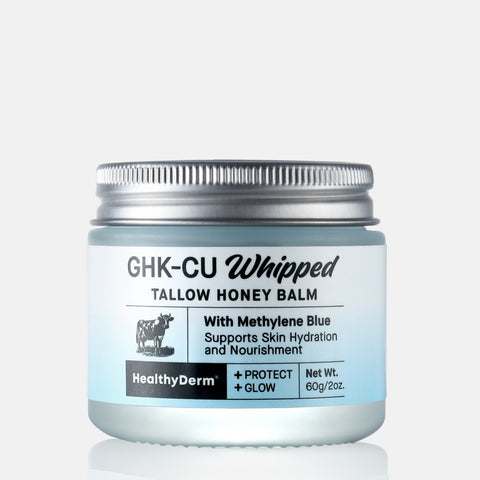
Our Crepe Renewal Body Treatment pairs grass-fed tallow with GHK-Cu on exactly the logic above, and it sits in the same evidence class as everything else in the first row of that table, which is to say supported by one industry-run trial on a different product. It is one option among several that meet the criteria, and the criteria matter more than the brand. You can see the rest of the range in crepey skin. If your concern is the face and neck rather than the body, start with how to get rid of crepey skin, and for the jaw and neck specifically, how to get rid of turkey neck covers the same evidence question for that area.
FAQ
What is the best lotion for crepey skin on arms and legs?
The one that combines a collagen-signalling active (copper peptides or a retinoid) with a genuinely lipid-rich base such as tallow, ceramides or shea, and that you will apply daily to damp skin after showering. A lotion with only humectants and no active will improve how skin feels but not how it is structured. No specific product has been shown superior to another on arm or leg skin, because the comparison has never been run.
Can crepey skin on arms be reversed?
Improved, not reversed. Texture, hydration and the fine crinkled appearance respond to consistent treatment, and the one randomised trial on upper arms (Kavali et al. 2021) found an active moisturiser beating a placebo moisturiser over twelve weeks on clinical grading and ultrasound skin density. Skin that has lost significant structural support will not return to how it was without in-office treatment.
Does drinking water help crepey skin?
Only if you are actually dehydrated. Once you are adequately hydrated, drinking more does not add moisture to the outer layer of skin, which is where crepiness lives. Topical lipids do far more for that layer than extra water intake.
Does collagen in a lotion do anything for crepey skin?
Not in the way the label implies. Bos and Meinardi (2000) argue that compounds much above roughly 500 daltons do not cross intact stratum corneum in useful amounts, and collagen and its hydrolysed peptides are well above that. Collagen in a lotion acts as a surface film, which can feel pleasant. It is not reaching the dermis where collagen is made.
Is body lotion enough, or do I need a prescription?
For most crepey skin on arms and legs, a well-formulated over-the-counter lotion used consistently is enough to get the available improvement. Prescription tretinoin is better evidenced for photoaging, but it is more irritating over large body areas and adherence tends to be poor. Talk to a dermatologist if you have significant sun damage or are not seeing change after three consistent months.
What causes crepey skin on legs specifically?
The same combination as the arms, weighted toward two factors: shins have very few sebaceous glands and dry out easily, and they take a lot of unprotected sun. Shaving and hot showers strip lipids further, which is why lower legs are often where crepiness appears first. Note that no randomised trial has measured crepiness on the legs, so this is mechanism rather than trial evidence.
How often should I apply lotion for crepey skin?
Once daily, after showering, is the realistic minimum. The trial on upper arms used twice daily for twelve weeks, so twice daily is the schedule that has actually been tested. Consistency matters more than the price of the product.
References
- Shuster, S., Black, M. M., & McVitie, E. (1975). The influence of age and sex on skin thickness, skin collagen and density. British Journal of Dermatology, 93(6), 639-643.
- Jacobsen, E., Billings, J. K., Frantz, R. A., Kinney, C. K., Stewart, M. E., & Downing, D. T. (1985). Age-related changes in sebaceous wax ester secretion rates in men and women. Journal of Investigative Dermatology, 85(5), 483-485.
- Kavali, C. M., Nguyen, T. Q., Zahr, A. S., Jiang, L. I., & Kononov, T. (2021). A randomized, double-blind, split-body, placebo-controlled clinical study to evaluate the efficacy and tolerability of a topical body firming moisturizer for upper arm rejuvenation. Aesthetic Surgery Journal, 41(6), NP472-NP483.
- Weiss, J. S., Ellis, C. N., Headington, J. T., Tincoff, T., Hamilton, T. A., & Voorhees, J. J. (1988). Topical tretinoin improves photoaged skin: a double-blind, vehicle-controlled study. JAMA, 259(4), 527-532.
- Bos, J. D., & Meinardi, M. M. H. M. (2000). The 500 Dalton rule for the skin penetration of chemical compounds and drugs. Experimental Dermatology, 9(3), 165-169.
- Badenhorst, T., Svirskis, D., Merrilees, M., Bolke, L., & Wu, Z. (2016). Effects of GHK-Cu on MMP and TIMP expression, collagen and elastin production, and facial wrinkle parameters. Journal of Aging Science, 4(3), 166. doi:10.4172/2329-8847.1000166
Revision history. Updated 12 October 2026. Six named studies and a numbered reference list were added, along with an original table grading the evidence for each treatment on arm and leg skin specifically. Two unsourced claims were corrected: the statement that collagen loss runs at 1 percent a year "from the mid-twenties" (the rate is now sourced to Shuster 1975, the starting age was not sourced and has been removed), and the statement that loss is "much faster in the first five post-menopausal years" (removed, because we could not open a primary paper reporting a postmenopausal rate). The commonly quoted figure of 30 percent dermal collagen lost in five postmenopausal years is named as unsupported. The Badenhorst 2016 figures were taken from Tables 2 and 3 of the paper itself rather than from summaries of it. A section setting out what the evidence does not cover was added.