



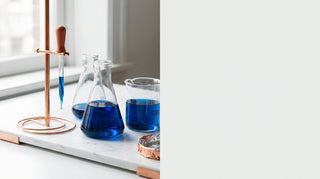
If you have started reading about anti-aging skincare in the last year, you have almost certainly run into the term GHK-Cu. It is one of the most researched copper peptides in skin science, and demand has climbed sharply as more people look for collagen support that does not rely on harsh actives. This guide explains what GHK-Cu copper peptides are, how they work, what the research actually shows, and how to use them, especially if you are caring for mature skin.
What is GHK-Cu?
GHK-Cu is a small, naturally occurring copper peptide: a chain of three amino acids (glycine, histidine, and lysine) bound to a single copper ion. Its technical name is copper tripeptide-1. Your body produces GHK on its own, but levels fall with age. Pickart and Margolina (2018) report plasma GHK falling from about 200 ng/ml at age 20 to about 80 ng/ml by age 60, a drop of roughly 60%. That decline tracks closely with the loss of firmness, slower repair, and thinning skin that many people notice over time.
Because it occurs in the body, GHK-Cu is generally well tolerated, which is part of why it has become a popular alternative for people whose skin reacts badly to stronger ingredients.
Why is GHK-Cu blue?
GHK-Cu is blue because of the copper in it. The peptide itself is colourless. When the glycine-histidine-lysine chain binds a copper(II) ion, the copper sits in a ligand field that absorbs light in the orange and red part of the spectrum, around 600 to 700 nm. What passes through, and what your eye sees, is the blue that is left over. This is ordinary coordination chemistry, the same reason copper sulphate solution is blue, and it is why GHK-Cu is often sold under the name blue copper peptide. The two terms mean the same molecule.
Three things worth knowing about the colour:
- Blue is a sign the copper is still bound. A GHK-Cu solution that has gone colourless or brown has usually lost or oxidised its copper, which means it is no longer the active complex.
- Depth of blue is not a strength meter. Colour intensity tracks concentration in a simple water solution, but in a cream or balm the base, the pH and any other pigment change what you see. You cannot judge potency by eye.
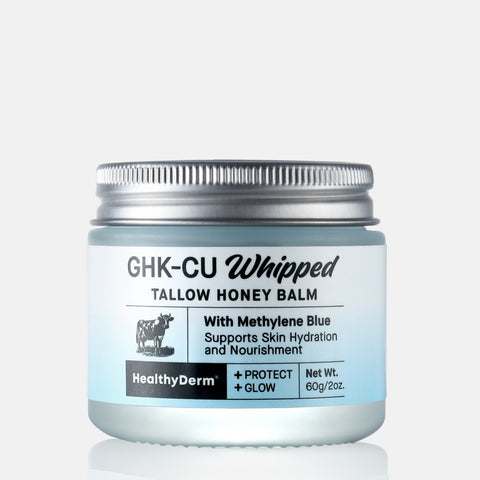
- Not every blue skincare product is blue because of GHK-Cu. Methylene blue, azulene from chamomile, and plain colourant are all used in blue formulas. HealthyDerm's balm is an example of the overlap: it contains both GHK-Cu and methylene blue, so its colour comes from both. If a product is blue, read the ingredient list rather than assuming.
The colour has no benefit of its own. It is a side effect of the chemistry that makes the peptide work.
How copper peptides work in skin
GHK-Cu is best understood as a signaling molecule. Rather than forcing a reaction the way an acid or a retinoid does, it sends repair signals that nudge skin toward healthier behavior. The peer-reviewed literature points to several mechanisms:
- Collagen and elastin support. GHK-Cu has been shown to stimulate the production of collagen and elastin, the proteins responsible for firmness and bounce.
- Skin remodeling. It helps regulate the enzymes involved in rebuilding the skin's support structure, which is why it is studied in the context of wound healing and post-procedure recovery.
- Antioxidant activity. Copper peptides help neutralize free radicals and support the skin's own defenses against environmental stress.
- Barrier and hydration. By supporting glycosaminoglycan production, GHK-Cu can improve how well skin holds moisture.
Pickart and Margolina's 2018 review in the International Journal of Molecular Sciences is the most useful open-access summary of this work, and it is free to read on PubMed Central.
The benefits of GHK-Cu for skin
Translated from the lab into the bathroom mirror, copper peptides are most associated with:
- Firmer-looking skin and improved elasticity over time
- Softened fine lines and a smoother surface texture
- A stronger, more resilient moisture barrier
- More even tone and a healthier overall glow
- Faster-looking recovery after procedures or irritation
These are supportive, cumulative effects, not overnight changes. Copper peptides reward consistency.
Why GHK-Cu suits mature skin
Mature skin is often dealing with two things at once: less of its own collagen and a lower tolerance for irritation. GHK-Cu is appealing precisely because it addresses the first without aggravating the second. It is one of the few firming actives that is gentle enough to use daily, which makes it a strong fit for skin over 40. If you have tried and abandoned retinol because of redness or peeling, copper peptides are worth understanding. We compare the two in copper peptide vs retinol.
GHK-Cu for hair
Copper peptides are also studied for the scalp, where they may support follicle health and a better environment for growth. The evidence is earlier-stage than it is for skin, but interest is real. We cover it in detail in does copper peptide hair growth actually work.
Topical vs. injectable GHK-Cu: do you need needles?
You will see GHK-Cu sold two ways: as injectable peptide vials and as topical skincare. Injectables are marketed within the biohacking and peptide-therapy world, but for skin goals most people do not need them, and they carry more risk, cost, and regulatory uncertainty. Well-formulated topical copper peptides deliver GHK-Cu where skin aging is visible: the surface and upper layers. For the vast majority of people pursuing firmer, smoother skin, a quality topical is the sensible starting point.
How to use copper peptides in your routine
Copper peptides are easy to layer:
- When: Morning, evening, or both. They are gentle enough for daily use.
- Order: Apply after cleansing and any water-based serums, then seal with a moisturizer or balm.
- Pairs well with: Hyaluronic acid, niacinamide, and nourishing oils or tallow.
- Be thoughtful with: Strong direct-acid exfoliants and high-strength vitamin C used in the same layer, which can compete with peptides. A simple fix is to use vitamin C in the morning and copper peptides in the evening.
GHK-Cu results: what to expect and when
Realistic timelines matter. Most people see surface improvements in hydration, smoothness and glow within the first few weeks, while firming and fine-line benefits build over roughly 8 to 12 weeks of consistent use. To see what change actually looks like, read GHK-Cu before and after: what the research shows.
Is GHK-Cu safe? Side effects to know
Topical GHK-Cu is considered well tolerated for most people. Because it is gentle, it is less likely to cause the stinging or peeling associated with stronger actives. As with any new product, patch test first, introduce it gradually, and avoid layering too many strong ingredients at once. Over-exfoliation is the usual culprit behind the so-called "copper uglies." We cover this fully in copper peptide side effects. This article is educational and not medical advice; check with a professional if you are pregnant, nursing, or managing a skin condition.
How to choose a copper peptide product
Not all copper peptide products are equal. Look for:
- A meaningful concentration of GHK-Cu, listed clearly on the label.
- A supportive base rather than a stripped-down one. Pairing GHK-Cu with skin-identical lipids, such as grass-fed tallow, helps the surface stay nourished while the peptide does its work.
- A short, clean ingredient list without unnecessary irritants or heavy fragrance, which matters for mature and sensitive skin.
- A brand that explains its formulation instead of hiding behind buzzwords.
HealthyDerm's GHK-Cu Whipped Tallow & Honey Balm was built on exactly this principle: clinical copper peptides delivered in a base of grass-fed tallow that mirrors skin's own lipids. You can browse the full range on our copper peptides collection.
Frequently asked questions
Why is GHK-Cu blue?
The copper ion at the centre of the peptide absorbs orange and red light, so the light that reaches your eye is blue. The peptide on its own is colourless. Losing the blue usually means the copper complex has broken down.
Is blue copper peptide the same as GHK-Cu?
Yes. "Blue copper peptide" is a common retail name for GHK-Cu, or copper tripeptide-1. Be aware that other ingredients, including methylene blue, also make products blue, so check the ingredient list rather than the colour.
Is GHK-Cu FDA approved?
GHK-Cu is used as a cosmetic ingredient (copper tripeptide-1) in topical skincare, where ingredients are regulated differently from drugs. Injectable peptide products are a separate category with different oversight. Always buy topical copper peptides from a transparent, reputable brand.
Does GHK-Cu help with acne?
Copper peptides are mainly studied for firmness, repair, and barrier support rather than acne. Their soothing, barrier-friendly profile can suit acne-prone skin, but they are not a dedicated acne treatment.
Can you use GHK-Cu without injections?
Yes. Topical copper peptides deliver GHK-Cu to the skin's surface and upper layers, which is where visible aging happens. Most people pursuing skin goals do not need injectables.
How long does GHK-Cu take to work?
Expect early surface improvements within a few weeks and firmer, smoother results over 8 to 12 weeks of consistent use.
Can you use copper peptides with retinol?
Many people alternate them, retinol on some evenings and copper peptides on others, to get the benefits of both while keeping irritation low. See copper peptide vs retinol.
Ready to add copper peptides to your routine? Explore the HealthyDerm copper peptides collection: clinical actives in an ancestral, skin-loving base.
References
- Pickart L, Margolina A. Regenerative and Protective Actions of the GHK-Cu Peptide in the Light of the New Gene Data. International Journal of Molecular Sciences. 2018;19(7):1987.
- Pickart L, Vasquez-Soltero JM, Margolina A. GHK Peptide as a Natural Modulator of Multiple Cellular Pathways in Skin Regeneration. BioMed Research International. 2015;2015:648108.
- Badenhorst T, Svirskis D, Wu Z. Physicochemical characterization of native glycyl-L-histidyl-L-lysine tripeptide for wound healing and anti-aging: a reference guide for researchers. Journal of Aging Science. 2016;4(2).
BioPeak USA
The article provides a useful overview of GHK-Cu and why copper peptides have attracted attention in skincare research. From a research perspective, factors such as peptide identity, purity, stability, characterization, analytical testing, and proper documentation are important when evaluating peptide materials. As copper peptide research continues to develop across skincare and biotechnology, transparent analytical information can support more reliable and reproducible research. BioPeak USA supports this research-focused area with RUO compounds and laboratory research materials, with an emphasis on quality and analytical documentation.