




The short answer
Copper peptide cream is a signalling product, not a tightening product. It tells skin cells to make more collagen, which is a slow structural change, and it does nothing in minutes. Published trials show measurable improvement in facial wrinkles and skin density over 8 to 12 weeks. No controlled trial has ever measured a topical copper peptide on loose skin of the neck or jawline specifically, so anyone quoting you a precise figure for what a cream does to a sagging jawline is making it up, including us until this page was corrected.
You can feel it before you see it. The jawline softens. The skin along the neck moves differently when you turn your head. Your cheeks sit lower than they used to. None of this happened overnight, but one morning you notice it, and from then on you cannot stop noticing it.
Loose skin after 50 is a structural problem, and most products marketed for firming and lifting are not structural solutions. They are optical illusions sold in expensive packaging. Copper peptide works through a different mechanism, and the difference between what tightens temporarily and what rebuilds slowly is worth five minutes before you spend another dollar.
Why skin loses firmness after 50
Skin is a three-layer organ, and loose skin is a failure of the middle layer, the dermis. The dermis is a dense mesh of collagen fibers providing structure and elastin fibers providing snap-back. When that mesh degrades, gravity wins.
Three things are happening at once after menopause.
Collagen is leaving faster than it is replaced. Skin collagen falls by roughly 1 percent a year across adult life, in sun-exposed and unexposed skin alike, and women have less of it than men at every age. That comes from Shuster, Black and McVitie (1975), restated with the 1 percent figure by Shuster (2020). You will often see this given as "starting in your mid-twenties," which this page used to say. No study specifies a start age, so it is gone.
Menopause accelerates the loss. Brincat and colleagues (1987) measured skin collagen content and skin thickness in postmenopausal women and found both declining at about 1 to 2 percent per postmenopausal year, with the decline tracking years since menopause rather than chronological age (Brincat et al., 1985).
Correction, October 2026. This page previously said that "research by Brincat et al. (1987) in the British Journal of Obstetrics and Gynaecology documented that women lose approximately 30% of their dermal collagen in the first five years after menopause." That was wrong in three ways and we are leaving the old sentence here so you can see it. The 1987 Brincat paper is in Obstetrics and Gynecology, not the BJOG. It does not report a 30 percent figure or a five-year window; it reports 1 to 2 percent per year. And the 30 percent claim, which circulates across the whole skincare and menopause industry, traces to a 2005 narrative review rather than to any primary study. On the measured numbers the five-year loss is closer to 5 to 11 percent. That is still a real and meaningful acceleration. It is not the structural collapse this page was describing.
Elastin is functionally gone. Unlike collagen, which your body can produce slowly throughout life, elastin is essentially non-renewable after puberty. Damaged elastic fibers are replaced with disorganised material. This is why skin that was stretched, by weight changes, pregnancy, or simple gravity over decades, does not bounce back.
The lipid barrier is thinning. Sebum production drops after menopause. Without adequate surface lipids the barrier becomes more permeable, water escapes faster, and the dermis holds less of it.
What most "firming" products actually do
Before getting to what works, it is worth understanding what does not.
Film-forming agents are the most common trick. Ingredients like DMAE, egg albumin and certain silicone polymers create a thin, tightening film on the skin surface. You feel an immediate pulling sensation. Your skin looks marginally tighter for a few hours. Then you wash your face and every bit of that firmness goes down the drain. Zero collagen was built. You rented the appearance of firm skin for an afternoon.
Hyaluronic acid is a fine ingredient, but it does not tighten loose skin. It holds water. Hydrated skin looks plumper, which can temporarily mask sagging, but hydration is not structure.
Oral collagen supplements have some evidence for skin hydration, but whether digested collagen fragments preferentially reach skin fibroblasts rather than being used anywhere else in the body is not established.
None of these addresses the core problem: fibroblasts producing less collagen, enzymes degrading what is produced, and weakened repair signalling.
How GHK-Cu copper peptide addresses loose skin
GHK-Cu, the glycyl-histidyl-lysine copper complex, works at the signalling level. Rather than coating the surface or temporarily inflating the dermis with water, it tells skin cells to rebuild the structural matrix.
Pickart and Margolina (2018) report that GHK changes the expression of about 31.2 percent of the human genes profiled in the Broad Institute's Connectivity Map, by 50 percent or more in either direction, with the changes favouring collagen synthesis, wound healing and stem cell function over inflammation and tissue degradation. Worth knowing who wrote that: both authors are affiliated with Skin Biology, a copper peptide skincare company, and the paper is a review of their own core ingredient. The gene data is interesting. It is not a clinical result, and a gene expression profile is not a measurement of anybody's face.
For loose skin specifically, four actions matter.
Collagen synthesis. GHK-Cu increases production of Type I collagen, the rigid scaffolding, and Type III collagen, the flexible support. The one study that compared it head to head against other actives is Abdulghani et al. (1998), and it is the most misquoted paper in this category. What it reports is response rates: 7 of 10 volunteers on a copper-binding peptide cream showed increased procollagen synthesis, against 5 of 10 on vitamin C, 5 of 10 on melatonin and 4 of 10 on tretinoin, over one month. The 70 percent figure everyone quotes is the share of people who responded at all, not the size of anyone's increase. With ten people per arm, the gap between 7 of 10 and 4 of 10 is also well inside what chance produces. This page previously said copper peptide "outperformed" vitamin C and tretinoin on the strength of it. That is more than the study supports.
MMP and TIMP rebalancing. Matrix metalloproteinases break down collagen and tissue inhibitors of metalloproteinases stop them. In aging skin the ratio tilts toward degradation. In cell culture work, GHK-Cu shifts it back by upregulating TIMPs and downregulating MMPs (Badenhorst et al., 2016, first half of the paper). You cannot build collagen effectively if enzymes tear it down as fast as you make it.
Glycosaminoglycan production. GHK-Cu increases synthesis of glycosaminoglycans, including the hyaluronic acid that holds water in the dermis. Unlike applying hyaluronic acid topically, this is the skin's own production.
Decorin synthesis. Decorin is a small proteoglycan that organises collagen fibrils into aligned bundles. Disorganised collagen is weak collagen, so better organisation matters as much as more of it.
The clinical data on firmness, read honestly
There are three pieces of human evidence worth knowing about, and they are not equally good.
The best one. Badenhorst et al. (2016) ran a randomised, double-blind, split-face trial in 40 women aged 40 to 65 over eight weeks, with 39 completing. Wrinkles were measured on one identified wrinkle near the eye using PRIMOS 3D imaging. Wrinkle volume fell 24.1 percent from baseline on the GHK-Cu side against 15.0 percent on the side that got the same serum base without it, and the GHK-Cu side also beat a Matrixyl 3000 product by 31.6 percent on volume reduction.
This page used to say GHK-Cu "reduced wrinkle volume by 55.8% compared to control." That is the misreading the whole category repeats. The 55.8 percent is the relative improvement over the control side, not an absolute reduction. Two more things the page should have said: the trial was funded by the company that made the tested serum, and the paper's own discussion credits the nano-carrier delivery system rather than the peptide for the wrinkle result.
The 12-week facial study. A GHK-Cu facial cream applied for 12 weeks by 71 women with mild to advanced photoaging produced improvements in skin density, thickness, laxity, clarity, fine lines and wrinkle depth. That study is Leyden et al., presented at the American Academy of Dermatology meeting in 2002. This page previously attributed it to Finkley, Appa and Bhandarkar (2005), which is a separate book chapter, and described the participants as "women aged 50 to 59." No participant ages were ever published for that trial, so the age range was invented somewhere upstream and we repeated it. It is also a conference abstract, which means the methods were never published in full.
The related line that GHK-Cu produced "dermal keratinocyte proliferation" came from the 2005 book chapter by way of Pickart and Margolina's review. It is the published wording and it is biologically muddled, since keratinocytes sit in the epidermis and not the dermis. The mechanism claims that are cleanly supported are different ones: increased integrin and p63 expression in epidermal basal cells, and increased collagen and elastin production in cultured dermal fibroblasts.
The weakest one, which used to be presented here as the strongest. This page said "a separate study using high-resolution ultrasound imaging tracked subjects applying GHK-Cu gel daily for three months and documented a meaningful increase in collagen density. Ultrasound does not lie about density the way photography can lie about appearance." What that refers to is a May 2023 press release from Yuvan Research Inc., a California company, promoting its own GHK-Cu gel. It reports 21 women over three months and an average 28 percent increase in subdermal echogenic density, which the release itself describes as correlating with collagen rather than measuring it. There is no published paper, no control arm, no p-values and no standard deviations. It is a company announcement about a company's own product. The old sentence about ultrasound not lying was a nice line attached to the least reliable item on the page.
For the full claim-by-claim version of this evidence, see our breakdown of GHK-Cu before and after.
Why the carrier matters as much as the peptide
Post-menopausal skin is lipid-depleted. Sebum production has dropped and the barrier is thinner. Applying a water-based serum to that skin is like painting a fence in the rain: much of it runs off before it penetrates.
The delivery vehicle determines how much GHK-Cu reaches the dermis where fibroblasts live. That is not a marketing point, it is the Badenhorst trial's own conclusion: its authors credited the carrier rather than the peptide for the measured result.
Tallow is dominated by oleic, palmitic and stearic acid, the same three fatty acids that dominate human sebum, and the barrier handles those lipids readily. This page previously said grass-fed beef tallow "shares roughly 55% of its fatty acid profile with human skin sebum." We removed that figure because we could not find a published comparison behind it, on this page or on the two others where it appeared. It is quoted all over the tallow category and credited to a source nobody names. Sebum also contains squalene, wax esters and sapienic acid that tallow does not, and no study shows tallow behaves like sebum, so a single similarity percentage was never the right way to describe it anyway.
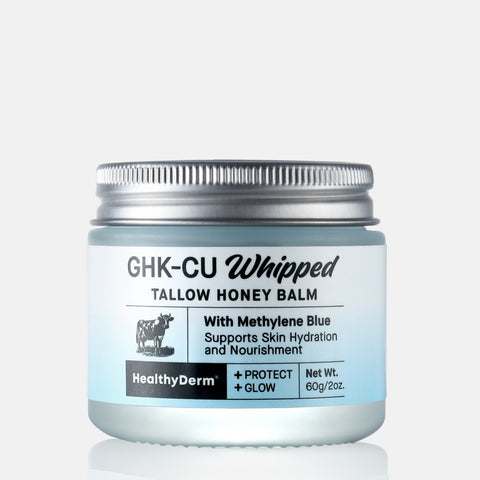
This is why the HealthyDerm Blue Balm uses grass-fed tallow as the vehicle for GHK-Cu: the carrier restores barrier lipids while delivering the peptide. That is a formulation rationale, not a claim that our balm has been measured against anything. It has not been.
For the reasoning on the second active, see our post on methylene blue and copper peptide in skincare.
What to look for in a copper peptide cream
If you are shopping specifically for loose skin, these are the criteria that matter.
GHK-Cu, not generic "copper peptide." The tripeptide glycyl-histidyl-lysine bound to a copper ion is the specific complex in the research above. Some products list "copper peptide" without specifying GHK-Cu, which may mean a different complex with less published evidence.
Not formulated alongside acids. This page used to specify a pH stability window of 5.0 to 6.5. We removed the numbers because we could not source them; the figure is repeated widely without a citation. What is documented is that GHK-Cu is sensitive to breakdown by carboxypeptidase enzymes (Pickart and Margolina, 2018), and the practical advice stands on firmer ground than the number did: if a product combines copper peptide with L-ascorbic acid or AHAs in the same formula, treat the copper peptide content as unreliable.
A lipid-based carrier for mature skin. Water-based serums can deliver copper peptide, but for post-menopausal skin with a compromised barrier an oil or tallow-based vehicle both penetrates better and repairs the barrier at the same time.
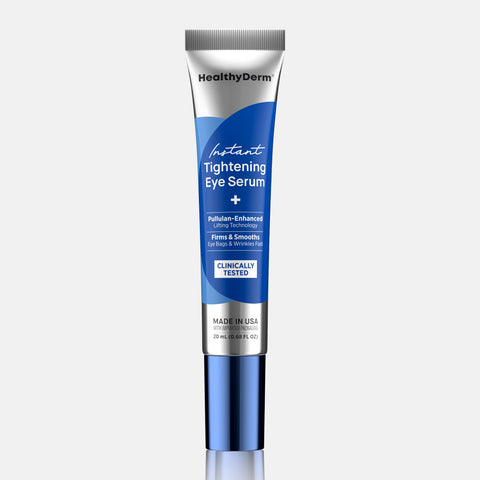
No film-forming agents sold as the main benefit. If a product promises instant tightening or visible lift in minutes, it is selling a film-former. GHK-Cu works in weeks, not minutes. Any product claiming instant results from copper peptide is misleading you about the mechanism.
For the wider picture, our guide on copper peptides for aging skin covers collagen, inflammation and barrier repair together.
Realistic results: what copper peptide can and cannot do
Copper peptide cream is not a facelift in a jar. Anyone selling it as one is lying.
Here is the limit of what the evidence supports, stated as precisely as the evidence allows. On facial skin, over 8 to 12 weeks of consistent use, published trials show reduced wrinkle volume and depth and improved density, thickness, laxity and clarity scores. The effect sizes are modest and come from small, mostly industry-funded studies.
What it cannot do: reverse severe gravitational laxity, replace lost subcutaneous fat volume, rebuild elastin to its pre-menopausal quality, or produce anything like a surgical result.
And the part this page was missing entirely. No controlled trial has tested a topical copper peptide on the neck or jawline. Every number above was measured on faces, mostly near the eye. Applying them to a softening jawline or a loose neck is an extrapolation, and we should say so rather than let the figures imply otherwise. If that is your main concern, our turkey neck guide grades every option, including this one, on the strength of its evidence for the neck specifically.
The honest framing: if your loose skin is primarily a collagen and matrix density problem, which is most cases of early to moderate laxity, GHK-Cu acts on that mechanism. If it involves significant fat pad descent or extensive elastin degradation, you are dealing with losses no topical ingredient reverses.
For women curious about copper peptide side effects before starting, the profile is mild: no peeling, no purging, no photosensitivity. Unlike retinol, copper peptide does not require weeks of irritation before improvement.
References
- Shuster, S., Black, M. M., & McVitie, E. (1975). The influence of age and sex on skin thickness, skin collagen and density. British Journal of Dermatology, 93(6), 639-643.
- Shuster, S. (2020). Osteoporosis, like skin ageing, is caused by collagen loss which is reversible. Journal of the Royal Society of Medicine, 113(4), 158-160.
- Brincat, M., Kabalan, S., Studd, J. W., Moniz, C. F., de Trafford, J., & Montgomery, J. (1987). A study of the decrease of skin collagen content, skin thickness, and bone mass in the postmenopausal woman. Obstetrics and Gynecology, 70(6), 840-845.
- Brincat, M., Moniz, C. J., Studd, J. W., et al. (1985). Long-term effects of the menopause and sex hormones on skin thickness. British Journal of Obstetrics and Gynaecology, 92(3), 256-259.
- Abdulghani, A. A., Sherr, S., Shirin, S., et al. (1998). Effects of topical creams containing vitamin C, a copper-binding peptide cream and melatonin compared with tretinoin on the ultrastructure of normal skin. Disease Management and Clinical Outcomes, 1(4), 136-141.
- Leyden, J., Stephens, T., Finkey, M., Appa, Y., & Barkovic, S. (2002). Skin Care Benefits of Copper Peptide Containing Facial Cream. American Academy of Dermatology 60th Annual Meeting, New Orleans, February 22-27, 2002, p. 68. Conference abstract, 71 women, 12 weeks.
- Finkley, M., Appa, Y., & Bhandarkar, S. (2005). Copper Peptide and Skin. In P. Elsner & H. Maibach (Eds.), Cosmeceuticals and Active Cosmetics: Drugs vs. Cosmetics (pp. 549-563). Marcel Dekker.
- Badenhorst, T., Svirskis, D., Merrilees, M., Bolke, L., & Wu, Z. (2016). Effects of GHK-Cu on MMP and TIMP expression, collagen and elastin production, and facial wrinkle parameters. Journal of Aging Science, 4(3), 1000166. Funded by Snowberry New Zealand Ltd, the maker of the tested serum.
- Pickart, L., & Margolina, A. (2018). Regenerative and Protective Actions of the GHK-Cu Peptide in the Light of the New Gene Data. International Journal of Molecular Sciences, 19(7), 1987. Both authors are affiliated with Skin Biology, a copper peptide skincare company.
- Yuvan Research Inc. (2023, May 25). Epigenetic mechanisms activated by GHK-Cu increase skin collagen density. Press release, EurekAlert, filed as a Business Announcement. Source of the 28 percent figure. Not a published study.
Revision history
October 5, 2026. Every statistic on this page was traced to its source. Seven things changed:
- A fabricated attribution was removed. The page credited Brincat et al. 1987 in the British Journal of Obstetrics and Gynaecology with finding a 30 percent dermal collagen loss in the five years after menopause. Wrong journal, and the paper reports no such figure. The measured decline is 1 to 2 percent per postmenopausal year.
- "Starting in your mid-twenties" was removed from the 1 percent a year figure. No study specifies a start age.
- "Reduced wrinkle volume by 55.8% compared to control" was corrected. That is a relative improvement over the control side; the absolute reductions were 24.1 percent against 15.0 percent.
- The unnamed "high-resolution ultrasound" study is a 2023 company press release for a competitor's product, measuring an ultrasound proxy, with no published data. It is now described as that.
- The 12-week study was reattributed from Finkley et al. 2005 to Leyden et al. 2002, 71 women, and the invented participant age range of 50 to 59 was removed.
- The claim that tallow "shares roughly 55% of its fatty acid profile with human skin sebum" was removed as unsourced, along with an unsourced pH stability range.
- Funding sources, author affiliations and sample sizes were added, plus a plain statement that no controlled trial has ever tested a topical copper peptide on neck or jawline laxity.
Suzanne McLarnon
Please stop this subscription.