




A century-old medical dye and a peptide first isolated from human blood plasma in 1973 have very little in common on paper. One is bright blue. The other involves copper. Neither sounds like something you would willingly put on your face before bed.
And yet methylene blue and GHK-Cu copper peptide are two of the most researched anti-aging compounds in dermatological science, and they happen to work through entirely different cellular pathways. That distinction matters more than most skincare marketing will tell you, because ingredients that target the same pathway often compete with each other. Ingredients that target different pathways can compound each other's effects.
Here is what the published research actually says about each one, why combining them makes biological sense, and what to look for if you are considering a formulation that brings them together.
Methylene Blue: The Mitochondrial Side of Aging
Most anti-aging ingredients work on the surface. They exfoliate, they hydrate, they stimulate collagen from the outside in. Methylene blue does something fundamentally different: it works inside the cell, at the mitochondrial level.
Your mitochondria are the energy factories of every cell in your body, including your skin cells. As you age, mitochondrial function declines. Cells produce less ATP (the energy currency that powers repair, regeneration, and collagen synthesis), and they produce more reactive oxygen species, or ROS, the free radicals that damage DNA and accelerate visible aging.
A foundational 2008 study by Atamna and colleagues, published in The FASEB Journal, tested methylene blue at nanomolar concentrations on cultured human fibroblasts, the cells responsible for producing collagen and elastin. It extended their replicative lifespan by more than 20 population doublings. The measured mechanism: methylene blue raised mitochondrial complex IV activity by about 30% and increased cellular oxygen consumption by 37 to 70%. This was cell-culture work, not a skin trial, but it is where the mitochondrial argument comes from.
A 2017 study by Xiong and colleagues in Scientific Reports took this further, testing methylene blue on human skin cells and on reconstructed three-dimensional skin models. Methylene blue increased fibroblast proliferation, improved wound-healing rates in culture, and in the skin models increased hydration and dermis thickness while raising expression of elastin and collagen 2A1. In the same experiments it delayed skin cell senescence more effectively than several commonly used antioxidants, including N-acetylcysteine and vitamin C.
The takeaway: in laboratory models, methylene blue gives skin cells more energy to do what they already know how to do. It does not force a response the way retinol does by accelerating cell turnover whether the skin is ready or not. It fuels the machinery. What has not been done is a large controlled trial of a methylene blue face product on real skin over months, so treat the mechanism as well supported and the finished-product claims as unproven. If you want a deeper look at how methylene blue compares to conventional anti-aging actives, we covered that in methylene blue for skin: what the research actually says. If you are choosing between oral and topical methylene blue products, our guide to methylene blue grades and brands covers what the labels mean.
GHK-Cu Copper Peptide: The Signal That Tells Cells What to Build
If methylene blue is the fuel, GHK-Cu is the blueprint.
GHK (glycyl-L-histidyl-L-lysine) is a naturally occurring human peptide that was first identified in blood plasma by Dr. Loren Pickart in 1973. When bound to copper, forming the GHK-Cu complex, it acts as a signaling molecule that tells cells to repair, rebuild, and regenerate.
The scale of its influence is striking. Pickart and Margolina, writing in the International Journal of Molecular Sciences in 2018, describe a Broad Institute gene-expression analysis in which GHK at 1 micromolar altered the expression of 31.2% of the 13,424 human genes assayed, roughly 4,190 genes. It raised expression in about 59% of those and lowered it in about 41%. That is a broad regenerative pattern in cultured cells, not a measurement taken in anyone's face.
For skin specifically, the most cited comparison is a small pilot study by Abdulghani and colleagues, published in Disease Management and Clinical Outcomes in 1998. Twenty healthy volunteers applied creams to thigh skin for one month. Procollagen synthesis by dermal fibroblasts rose from baseline in 7 of the 10 people using the copper-binding peptide cream, compared with 5 of 10 on vitamin C and 4 of 10 on tretinoin. Those numbers are the proportion of people who responded, not the size of the collagen increase, and they are often quoted incorrectly as "70% more collagen". With ten people per arm and one month of use, it is a signal worth knowing about and not a definitive result.
The broader literature supports the mechanism: GHK-Cu stimulates production of both Type I collagen (structural support) and Type III collagen (flexibility and repair), increases elastin and glycosaminoglycan synthesis, and supplies copper as an essential cofactor for lysyl oxidase, the enzyme responsible for proper collagen cross-linking.
Beyond collagen, GHK-Cu has been shown in laboratory work to support blood vessel and nerve outgrowth, reduce inflammatory signaling, and activate the proteasome system, the cell's internal cleanup crew.
The takeaway: GHK-Cu provides the molecular instructions that direct skin cells toward repair. It is the command, not the power supply.

Methylene Blue and Copper Peptide: Why the Combination Works
Here is the logic, and it is not complicated once you see the two pathways side by side.
Methylene blue optimizes cellular energy production. It helps aging mitochondria work more efficiently, giving fibroblasts the ATP they need to synthesize collagen, elastin, and other structural proteins. Without adequate cellular energy, even the best repair signals go nowhere. A fibroblast that cannot produce enough ATP simply cannot build collagen, no matter how many growth signals it receives.
GHK-Cu provides the repair signals. It activates genes associated with collagen production, wound healing, anti-inflammation, and tissue remodeling. But those gene activations require energy to execute. Protein synthesis is one of the most energy-intensive processes in the cell.
When you combine them, you are addressing both sides of the equation: the energy to rebuild and the instructions for what to rebuild. One without the other is like having a construction crew with no blueprint, or a perfect blueprint with no workers.
This is not the same as layering two serums that both target, say, surface-level hydration. These are complementary mechanisms operating at different points in the cellular repair chain.
Being straight about the evidence. Both ingredients have real individual research behind them, almost all of it in cell culture and skin models rather than in controlled human trials of a finished cream. There is no published trial of methylene blue and GHK-Cu combined in a single formulation. The synergy argument rests on the established mechanism of each ingredient, not on a head-to-head study, and anyone who tells you otherwise is selling something.
Beef Tallow as a Carrier for Copper Peptide Skincare
Here is where formulation science gets interesting, and where most brands get lazy.
You can have the best actives in the world, but if the delivery system cannot get them past the skin barrier, you are paying for expensive lotion.
This is one reason grass-fed beef tallow has emerged as a compelling carrier for both methylene blue and copper peptides. Tallow is dominated by oleic, palmitic and stearic acid, the same three fatty acids that dominate human sebum and the lipids of the skin barrier. That overlap is why tallow tends to sit well on skin rather than being resisted by it. You will see a specific percentage of "similarity" quoted around the internet, including in an earlier version of this article. We removed it, because we could not trace it to a published comparison and skin lipid composition varies too much between people for a single number to mean much. For mature skin, which produces less sebum after menopause, a biocompatible lipid carrier is a reasonable choice.
Tallow also brings its own nutritional payload: vitamins A, D, E, and K, plus conjugated linoleic acid, which has shown anti-inflammatory properties in skin research. It helps restore the lipid barrier that thins with age, which is one of the foundational issues of post-menopausal skin. We explored why beef tallow works for mature skin in more detail previously, and looked at the evidence base itself in is beef tallow good for skin.
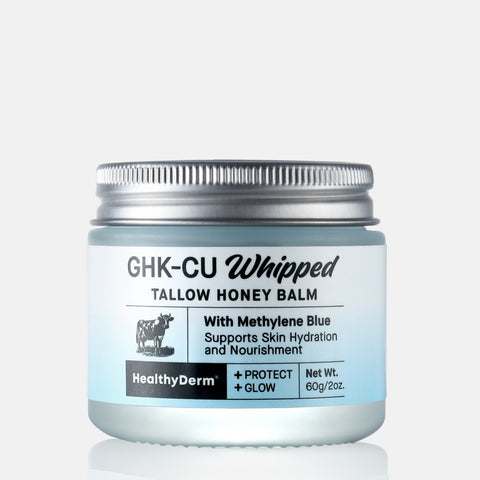
When you combine methylene blue, GHK-Cu, and tallow in a single formulation, you get three layers of activity: mitochondrial energy support, regenerative signaling, and lipid barrier restoration through a carrier that skin recognises. Each ingredient works on a different pathway rather than competing for the same one. This is the formulation logic behind the HealthyDerm Blue Balm.

What to Look for in a Methylene Blue and Copper Peptide Product
Not all formulations are equal. If you are evaluating a product that combines these ingredients, here is what matters:
A stated methylene blue concentration. Topical skincare products generally sit somewhere between a fraction of a percent and a couple of percent, but there is no established optimal concentration for skin, and higher is not better: the Xiong work showed its effects at low concentrations. What matters more than the number is that the brand states one at all. At sensible levels methylene blue absorbs clear within seconds despite being blue in the jar.
GHK-Cu source and stability matter. Copper peptides are sensitive to pH and can degrade if not properly formulated. Look for products that specify GHK-Cu, not a generic "copper peptide complex", and that use airless or opaque packaging.
The carrier base tells you how seriously the brand takes delivery. Water-based serums work for some actives but are not ideal for lipid-soluble compounds. Tallow-based or lipid-rich formulations suit both of these.
What is not in the product also matters. Simpler formulations with fewer ingredients often perform better because there is less chance of interactions that destabilize the actives. A five-ingredient formula where every component serves a purpose is generally more reliable than a thirty-ingredient cocktail.
Copper Peptide and Methylene Blue Results: Realistic Timeline
Skincare that works at the cellular level does not produce overnight results. Here is what the research suggests, and what it does not:
Barrier repair and comfort are often noticeable within the first week, especially if you are coming from a compromised moisture barrier. That is the tallow base, and it is the one effect you can expect reliably.
Skin texture and hydration typically shift within two to four weeks.
Some people see the opposite first: a stretch of dullness, fine flaking or small congestion bumps in the early weeks, which the copper peptide community calls the copper uglies. Our guide to copper uglies and copper peptide side effects has a week-by-week table for telling that adjustment period apart from genuine irritation, and for deciding whether to continue.
Collagen and firmness improvements require patience. The GHK-Cu collagen work runs on an 8 to 12 week timeline. Collagen remodeling is a slow biological process, and any product that promises visible firming in days is either using a temporary film-forming agent, which is not the same thing, or overpromising.
Cumulative benefits continue building over months of consistent use. Neither ingredient is one where the effect wears off with continued application.
If you have been looking for a formulation that addresses cellular energy, repair signaling, and barrier restoration in a single step, the HealthyDerm Blue Balm was built around exactly this research.
References
- Atamna H, Nguyen A, Schultz C, et al. Methylene blue delays cellular senescence and enhances key mitochondrial biochemical pathways. The FASEB Journal. 2008;22(3):703-712.
- Xiong ZM, O'Donovan M, Sun L, Choi JY, Ren M, Cao K. Anti-Aging Potentials of Methylene Blue for Human Skin Longevity. Scientific Reports. 2017;7(1):2475.
- Pickart L, Margolina A. Regenerative and Protective Actions of the GHK-Cu Peptide in the Light of the New Gene Data. International Journal of Molecular Sciences. 2018;19(7):1987.
- Abdulghani AA, Sherr S, Shirin S, et al. Effects of topical creams containing vitamin C, a copper-binding peptide cream and melatonin compared with tretinoin on the ultrastructure of normal skin. Disease Management and Clinical Outcomes. 1998;1(4):136-141.
Last reviewed September 2026. This revision corrected the Abdulghani collagen figures, which had been stated as percentage increases in collagen rather than the proportion of volunteers who responded; removed an untraceable claim that tallow is "55% similar" to human skin lipids; corrected the GHK-Cu gene figure to 31.2% of the genes assayed rather than of the genome; and removed a reference to anti-cancer gene expression, which does not belong on a skincare page.
Chelle
Love how this makes my skin look and feel, it is great for after microneedling!
Maria
This is going to be good. When you start talking about mitochondria, ATP and ROS my ears perked up from what I know about fasting and autophagy. I can’t wait until I receive my order.